

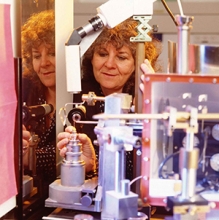
Professor Ada Yonath, one of the Weizmann Institute’s most illustrious scientists, passed away on Monday August 31 2026, at the age of 87. Ada was born in Jerusalem in 1939 to Polish Jewish parents. Already from an early age, she displayed a deep interest for science, a talent that would ultimately shape the course of her life. When the family moved to Tel Aviv, Ada continued her studies nurturing her growing interest in science.
She earned a BSc in Chemistry in 1962 and in 1964 a MSc in Biochemistry at the Hebrew University in Jerusalem.
In 1968, she completed her PhD at the Weizmann Institute of Science in Rehovot, followed by postdoctoral studies in the USA, initially at the Mellon Institute (1969) and later at the Massachusetts Institute of Technology (1970). Returning to Israel, she was nominated faculty member at the Structural Biology Department of the Weizmann; and from 1986 to 2004 she headed a research unit at the Max Planck Society in Hamburg, Germany.
Prof Yonath's scientific journey was marked by curiosity, courage, determination, and eventually an extraordinary success. As an integral member of the scientific endeavor of the Weizmann Institute, she decided to tackle the very difficult problem of solving the 3D structure of the ribosome, the intracellular organelle containing protein and RNA, the protein-making machinery of the cell and as such a fundamental component of life. At the time, solving the 3D structure of the ribosome was considered by the international structural biology community an impossible task. Ada persisted for a few decades in searching suitable experimental conditions that may lead to the formation of single and stable crystals of the ribosome, to be employed for X-ray diffraction. She and her colleagues conducted some 25,000 crystallization experiments before succeeding in obtaining suitable and homogeneous crystals.
Her life story reflects the long road to a fundamental scientific discovery. Her research has left a profound impact on science in Israel and around the world. Solving the 3D structure of the ribosome transformed our understanding of the biosynthesis of proteins in the cell; moreover contributed to our understanding of the function of the antibiotics and the mechanism whereby bacteria develop resistance, thus paving the way to the development of effective new antibiotics. She continued to conduct excellent research, publish, and collaborate with several scientists almost until her final days.
In 2009 Ada Yonath was awarded the Nobel Prize in Chemistry shared with Thomas A. Steitz and Venkatraman Ramakrishnan. She was one of the very few womens laureates in Chemistry at the time.
Ada was elected member of numerous scientific academies, such as the USA National Academy of Sciences, the Royal Society, the German National Academy of Sciences Leopoldina, the Israel Academy of Sciences and Humanities. In 2015 she was elected honorary foreign Member of the Accademia Nazionale dei Lincei; ever since she was an active fellow of the Lincei and contributed by delivering some extraordinary conferences and giving precious scientific advice. She was given many honors including the Wolf Prize in Chemistry, the Israel Prize, the Harvey Prize, the L'Oréal-UNESCO Award for Women in Science; and finally the ”World’s Best Grandma Award,” given to her by her grand-daughter, Noa.
____
Prof. Ada Yonath (1939-2026). Photo: Miki Koren