

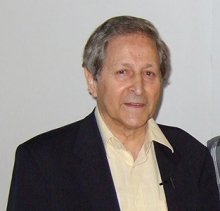
Claude Cohen-Tannoudji was elected to the Accademia Nazionale dei Lincei in 1996, one year before winning (along with Steven Chu and William D. Phillips) the Nobel Prize in Physics, awarded to him “for the development of techniques for cooling and trapping atoms with laser light.” For the same discoveries, the Accademia dei XL in Italy had awarded him the Matteucci Medal. Claude Cohen-Tannoudji was an elegant scientist who was able to address, with unique depth, the most subtle aspects of the interaction between light and atoms, gaining insight into crucial phenomena in optics and quantum electrodynamics. His unparalleled kindness and refinement led him to interact constructively with everyone. As early as his doctoral studies (1962), he was part of the group led by Jean Brossel and Alfred Kasler; the latter would go on to receive the Nobel Prize in 1966.
The Laboratoire Kastler Brossel dell’Ecole Normale Supérieure (ENS) in Paris The laboratory found in Claude Cohen-Tannoudji a constant source of inspiration for countless researchers who went on to become great scientists, starting with Serge Haroche (Nobel Prize 2012) and Alain Aspect (Nobel Prize 2022 and Linceo). His connection to the Italian school of atomic physics—founded in Pisa by Adriano Gozzini (Linceo 1979–1994), featuring fruitful exchanges of researchers and ideas that would later expand successfully to Florence, where he served on the scientific council of LENS (European Laboratory for Nonlinear Spectroscopy), and to the University of Trento. A unique characteristic of Claude Cohen-Tannoudji was that he was both a theorist and an experimentalist. A great teacher, his lectures on quantum mechanics in the early 1970s at the University of Paris—published in the volume “Mecanique Quantique” with Franck Laloe and Bernard Diu in 1973—have inspired generations of scholars and remain an international reference. In the second half of his career, he was a professor at the Collège de France, which led him to teach courses in Pisa, Italy, and to host courses for Italian students in Paris. He received numerous honors, such as the Ordre national de la Légion d'honneur, which fostered scientific exchanges between our academy and the French academic community. Among his other honors, it is worth noting the awarding, in 1996, of the CNRS (Centre National de la Recherche Scientifique) Gold Medal. In his award acceptance speech, Claude Cohen-Tannoudji highlighted the importance of the education he received during his childhood and adolescence. Born in Constantine, Algeria, to a Sephardic Jewish family, and having lived there until he entered the École Normale Supérieure (ENS) in Paris, he said he was not a practicing Jew but, visibly moved, thanked his father, who—by involving him in reading and interpreting the Talmud—had taught him not to be superficial, to think and rethink while continually deepening his knowledge. And it is precisely this, he said, that led him to understand the mechanism that, surprisingly, made it possible to cool an atomic gas with light to millionths of a degree above absolute zero. He called the technique “Sisyphus cooling,” drawing inspiration from the Greek myth of Sisyphus: here, the atoms “clad in light” are forced to move constantly “uphill,” losing kinetic energy and, as they slow down, cooling to temperatures close to absolute zero. The name Claude Cohen-Tannoudji gave to this physical phenomenon evokes the figure of a man deeply involved in culture across the board, a champion of the power of knowledge as a vehicle for social peace. His programs for the shared growth of Israelis and Palestinians were significant, as were his initiatives against landmines. He was a loyal and enthusiastic advocate of science—a science driven by curiosity and free to be a vehicle for progress. The results of his own curiosity have made possible technological advancements that were once unimaginable, such as the practical construction of sensors and atomic clocks that measure time with greater precision than ever before.
Photo Credits: Di Amir Bernat - I phtographed., CC BY-SA 4.0, https://commons.wikimedia.org/w/index.php?curid=4104959