

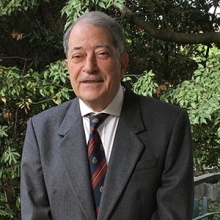
Sergio Spagnolo, born in La Spezia on June 14, 1941, arrived in Pisa in 1959 as a student at the Scuola Normale Superiore. In 1963, he earned his degree in mathematics from the University of Pisa under the supervision of Aldo Andreotti, and in the same year received his diploma from the Scuola Normale. He then continued his training at the Scuola Normale, where he remained as a postgraduate researcher and later as an assistant professor. After academic positions in Cagliari and Parma, he returned to the University of Pisa in 1974 as a full professor of Mathematical Analysis, a position he held until 2011. He also maintained a lasting connection with the Scuola Normale Superiore, where he taught an annual course from 1972 to 2002. In addition to his teaching and research activities, he held important institutional positions: he served as director of the then-Institute of Mathematics at the University of Pisa, was a member of the scientific bodies of the Italian Mathematical Union and the National Institute of Advanced Mathematics, and chaired the Doctoral Program in Mathematics at the University of Pisa.
His scientific work also had a significant international dimension. He taught courses and gave lectures at leading institutions, including the Collège de France, the Courant Institute in New York, Imperial College London, the Fields Institute in Toronto, the International Centre for Theoretical Physics in Trieste, Fudan University in Shanghai, and Academia Sinica. He also participated in major international scientific conferences, such as the 1984 Taniguchi Symposium and the 1991 Petrowski Conference.
Spagnolo’s research has focused on several fundamental issues in the theory of partial differential equations, which he has addressed with consistency and depth: the convergence of solutions as operators vary, the regularity of solutions, and the well-posedness of Cauchy problems. His early work on elliptic and parabolic equations laid the foundation for the theory of G-convergence, a now-classical theory that also plays an important role in the study of homogenization problems; this theory served as a precursor to the theory of Gamma-convergence developed a few years later by Ennio De Giorgi, with whom Spagnolo shared a deep personal and scientific bond. He also studied the regularity of solutions to elliptic equations, contributing to the understanding of the conditions that determine their continuity properties.
A central theme of his scientific work has been the study of hyperbolic equations, particularly in cases of weak hyperbolicity, in which the classical assumptions are not sufficient to guarantee the well-posedness of the Cauchy problem. His research has delved into the conditions of existence, uniqueness, and continuous dependence on the initial data, while also highlighting phenomena of non-uniqueness and situations where the problem is not well-posed. In particular, he has addressed problems related to hyperbolic systems with multiple characteristics, studying the conditions that allow for well-posedness and the role of the regularity of the coefficients. Closely linked to these studies was his focus on the regularity of solutions, particularly in the analytic and Gevrey classes. He thus addressed delicate issues such as the propagation of analyticity and the global existence of analytic solutions for nonlinear hyperbolic equations and systems. He also worked on Kirchhoff’s equations, which model, among other things, the nonlinear vibrations of a string, studying problems of global existence and nonlinear perturbations. Taken together, these contributions reflect research that focuses on the structure of the equations and the deep relationships between regularity, propagation, and the behavior of solutions.
In addition to his research, Spagnolo devoted a great deal of energy to teaching, offering numerous courses in Mathematical Analysis 1, Mathematical Analysis 2, and Introduction to Analysis, particularly in the Mathematics degree program at Pisa. In this way, he has contributed to the education of many generations of mathematicians. His teaching has left a mark that extends far beyond individual lectures: those who attended his courses could often be recognized by the way they structured their teaching and presented scientific results. His style has been passed down over time through students who have internalized not only the mathematical content but also a way of organizing their thoughts, developing an argument, and communicating mathematics. This influence, difficult to describe through titles and publications, represents an essential part of his legacy: an influence that continues to live on in the work of those who learned from him and, in turn, teach and conduct research. Rigor and elegance characterized his entire career: the rigor of one who makes no concessions to approximation and sees every proof through to the end; the elegance of one who seeks economy of means and clarity of structure in his arguments. These qualities were complemented by modesty, intellectual honesty, and a courtesy that earned him unanimous esteem within the scientific community.
Throughout his career, he has received major awards, including the Bartolozzi Prize from the Italian Mathematical Union in 1973, the Mathematics Prize from the National Academy of Sciences (known as the “Accademia dei XL”) in 1991, appointment as a corresponding member of the National Academy of the Lincei in 1998, followed by full membership in 2021, and the Order of the Cherubino from the University of Pisa in 1999. In 2013, he was awarded the title of professor emeritus by the University of Pisa.
The passing of Sergio Spagnolo leaves a void in Italian mathematics, but his legacy lives on through his achievements and his students. The mathematical community expresses its gratitude in his memory and extends its deepest condolences to his family, colleagues, and students.