

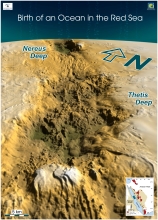
A conference at the Accademia dei Lincei has benn dedicated to one of the most fascinating and significant geological phenomena in the Earth’s deep history: the formation of a new ocean in the region of the Gulf of Aden, the Red Sea, and the Danakil or Afar Depression in East Africa. In this area, where today a rift or deep trench can be observed crossing the Ethiopian desert parallel to the Red Sea, it is possible to observe in real time the processes that transform a continent into an ocean basin. This is the only place on the planet where this mechanism, active for millions of years, can be studied directly on the Earth’s surface, thanks to the emergence of portions of the crust that elsewhere lie hidden beneath the oceans.
The Afar region, which is the lowest point in Africa at 155 meters below sea level, is the junction where three tectonic plates meet and diverge: the Arabian, the Nubian (or African), and the Somali plates. Their gradual divergence is paving the way, over tens or hundreds of millions of years, for the formation of a new ocean destined to separate East Africa from the rest of the continent. The area is characterized by intense volcanic and seismic activity accompanying the separation of the plates, which allows for the recording of crustal deformation through geodetic and seismic techniques.
During the meeting, models were presented showing how extension rate, mantle temperature, and surface processes influence the formation of continental margins with varying degrees of magmatic activity. The obliquity of the rift contributes to the segmentation of the fracture zones, generating complex systems in which some segments propagate, others overlap, and still others are abandoned, resulting in an irregular distribution of deformation and volcanism. New reconstructions of the separation between the Nubian and Arabian plates have made it possible to distinguish with greater precision where the Red Sea is still supported by stretched continental crust and where, instead, oceanic crust is already forming.
One particularly debated aspect concerns the nature of the lithospheric mantle beneath the Arabian Peninsula. Isotopic analyses show that the magmas retain a very ancient chemical signature dating back to the Proterozoic, indicating a heterogeneous mantle composed of deep, ancient domains alongside younger, depleted portions. It has also emerged that magmatic intrusions into the lower crust may have slowed the breakup of the continent, delaying the deformation necessary for the onset of oceanic expansion. This finding calls for a reconsideration of the relationship between magmatism and oceanic rifting, often interpreted as an accelerating factor, but which in this case appears to have acted as a temporary brake.
The new insights offered by thermobarometry and ab initio petrology now allow us to reconstruct the conditions of deep rock formation with greater precision and to better understand the processes occurring in the Earth’s mantle. The event represented a highly valuable interdisciplinary exchange, bringing together geology, geophysics, geochemistry, volcanology, and natural history around a phenomenon that continues to shape our planet before our very eyes and that, in the long term, will redraw the geography of Africa.
The meeting also provided an overview of the history and geography of the Danakil Depression, explaining the origins of the terms “Afar” and “Danakil” and describing the extreme nature of its environments, which also played a significant role in human evolution—from various “pre-hominid” species all the way to Homo sapiens.